
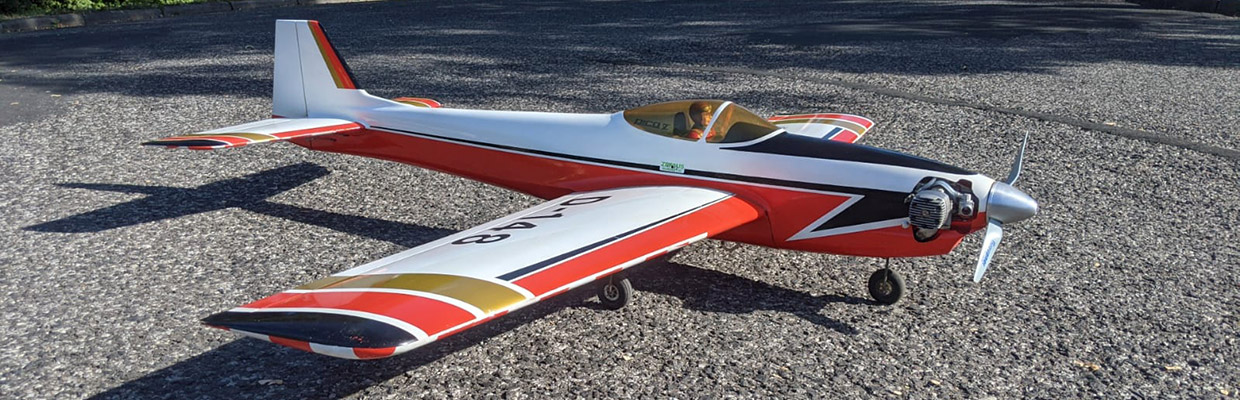
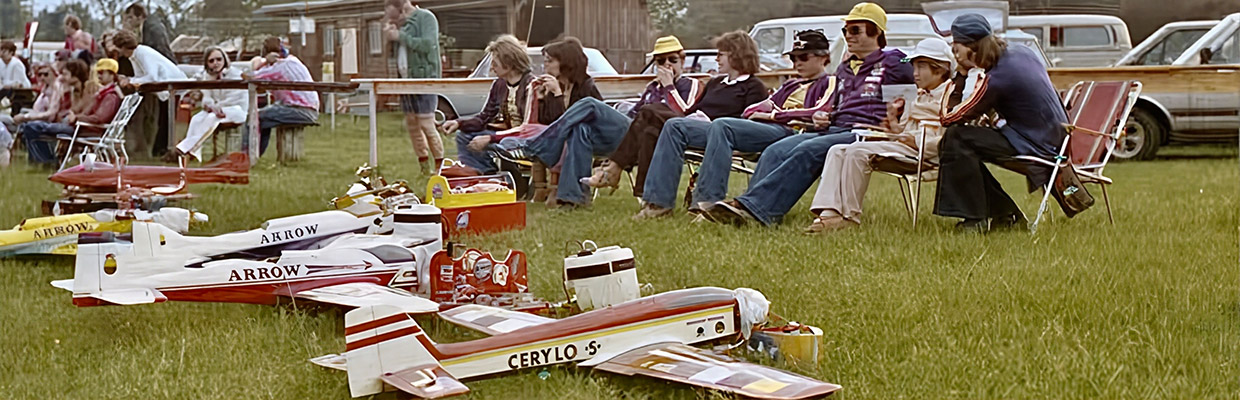
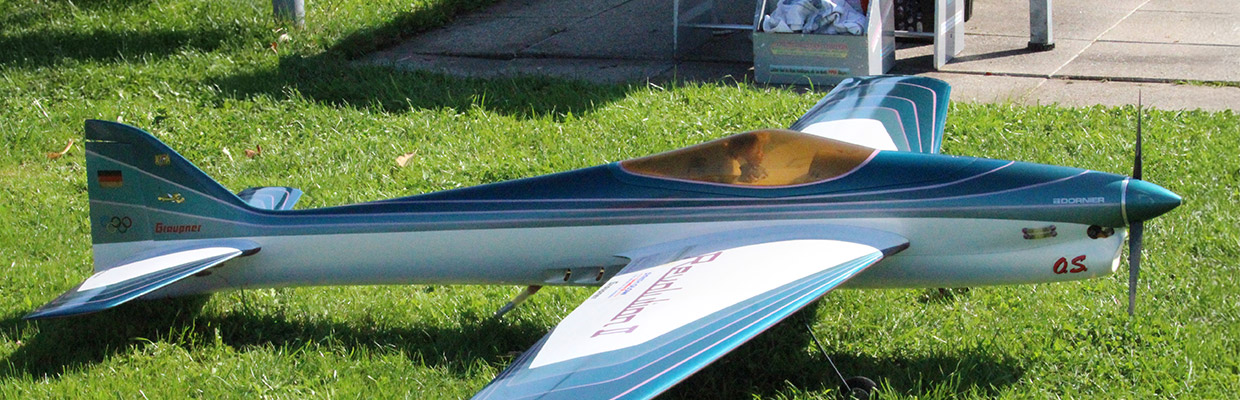
In 1974, Bill Bennett, president of the Circus Circus Group in Las Vegas, launched the very first competition between the best F3A pilots of the time. The world’s best pilots were invited by the hotel. For the first time ever, prize money was offered. The event was named the Tournament of Champions, or TOC for short.
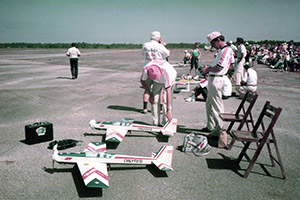
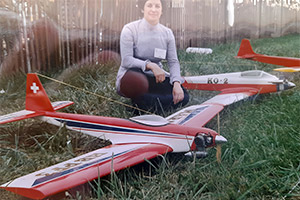
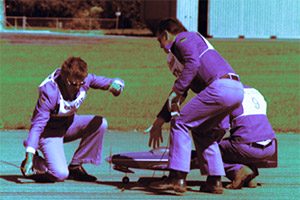
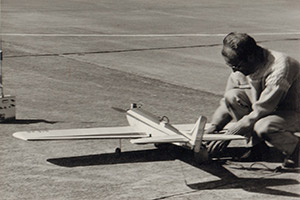
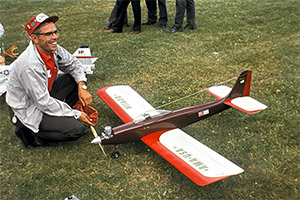
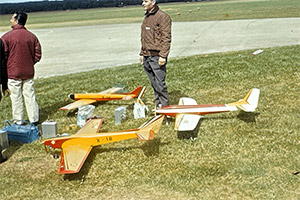
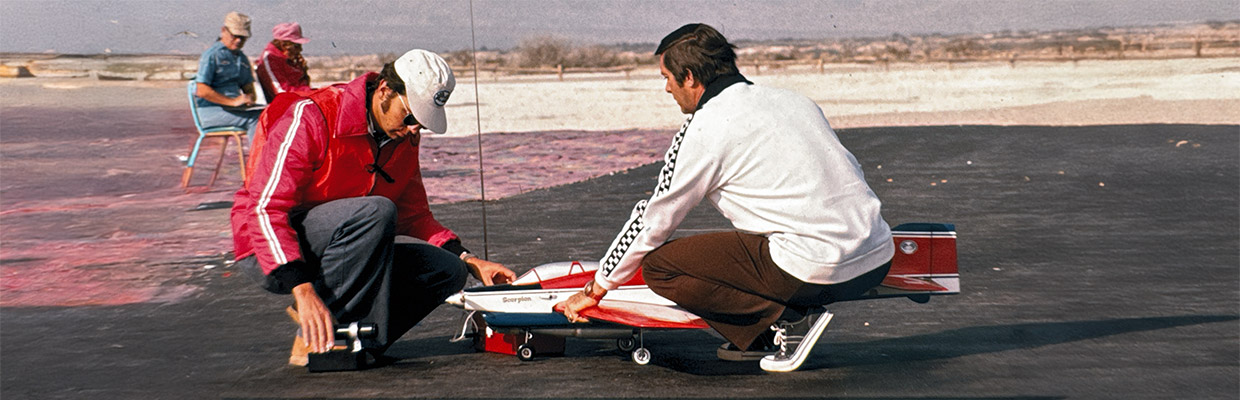
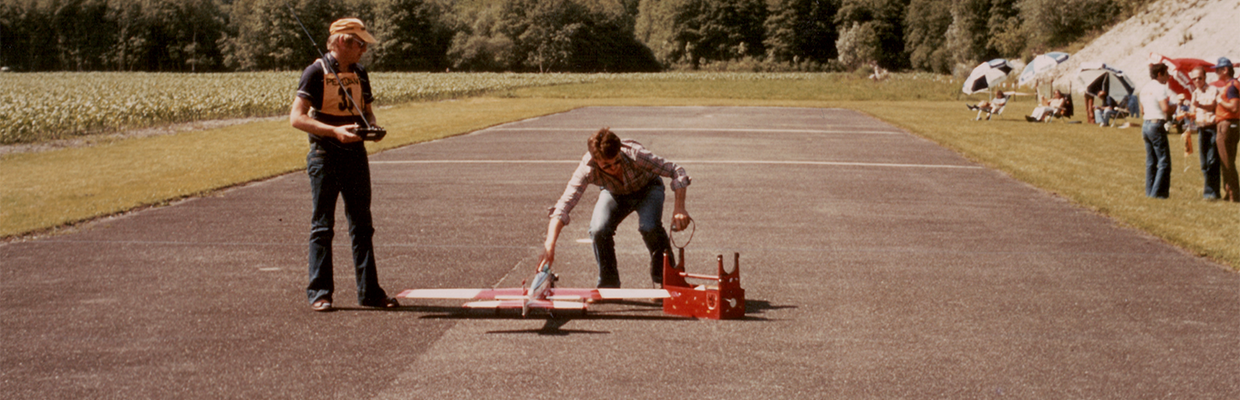
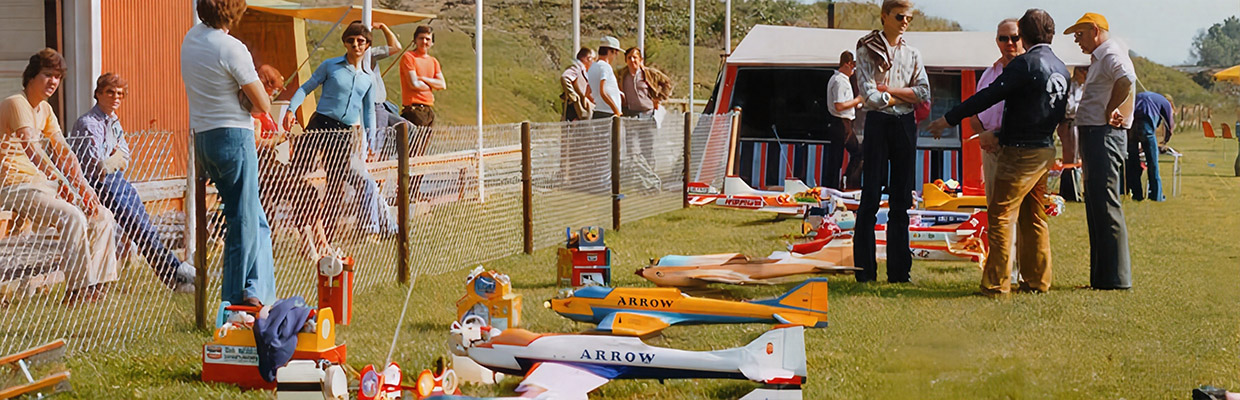
On a related note: below you will find some unlabelled photos. These photos are numbered. If you have any information about the photos, please let us know. Simply send an email to editor@classicpattern.com
Dezember 1974: Las Vegas, Nevada – Circus Circus Hotel/ Spa/ Kasino – Model Airplane News – Tower Hobbies – $11,000
32 R/C model aircraft . . . a patch of asphalt smack in the middle of the American desert . . . 21 of America’s top R/C’ers . . ., national champions from England, Canada, Austria, Japan, Mexico, Liechtenstein, Sweden . . . hundreds of spectators . . . and weather ranging from great to pretty Gold.

All of these diverse elements came together in one of the most impressive R/C pattern shows of all time—the First Annual International Tournament of Champions, cosponsored by M.A.N. and Circus Circus.
Circus Circus, and Walt Schroder, M.A.N.’s publisher, conceived the basic format for this first Tournament in the fall of 1974 and through efforts of many dedicated people–in and out of modeling—it reached reality on December 6, 7 and 8 of the same year.

Putting such an affair together in a few, short months is a pretty impressive performance and was topped only by the performances of the competitors themselves.

Organization and Operation were outstanding—not without problems—but equal to any top international 1. Tournament of Champions!

The desert at its best— not without problems—but equal to any top international effort this writer has yet seen.
Key to any meet is a cadre of judges that are knowledgeable and consistent. Such a group was formed by vote of the invited contestants and included judges with World Championship, Nationals and wide local event experience.

California sent Bill Northrup, Sam Crawford, Dave Lane, Bob Upton and Whit Stockwell; New Yorkers Alvin Sager and Walt “Butch” Schroder also joined in judging chores along with Bob Reuther, Tennessee; Dick Austin, Alabama; Travis Mc Ginnis, Colorado; Bob Johnson, Illinois and Larry Sartor, Oklahoma. Not to be outdone, the distaff side was ably represented by Mississippi’s Julie Woods.

Because of its international flavor, the Tournament of Champions was down through the new FAI pattern schedule that included Take-off, Figure M, Cuban – Eight.
Double Immelmann, Slow Roll, Three Outside Loops, Eight Point Roll, Top Hat, Rolling Eight. Three-Turn Spin. Rectangular Approach and Landing and as the rules require.

Each pass had a maneuver performed. This FAI pattern has a top score of 2,000 points and with six judges used on each flight.
Original plans called for six rounds with finals for top qualifiers. Such procedures required two contestants flying from one circle, a practice common to American events.

Unfortunately, the foreign visitors were unaccustomed to this procedure, and a change was made to four rounds after the flyer`s meeting. Thursday evening, some upset was evident with a few competitors, but the decision stood.

A good thing as we saw it : some foreign competitors wander all over the 30-meter circle, which could have posed some real problems for anyone trying to land an aircraft. Actually FAI rules permit a flyer the run of the 30-meter circle , and all foreign flyers used it to the fullest.

Mike Birch of England flew from the far side: Hanno Prettner right smack in the middle, many used the near side, with most Americans standing near the judges.
The number of rounds controversy proved to be the one and only problem and was soon forgotten. Some flyer arrived several days early for practice sessions, and while no one flyer seemed a stand-out during the early flights.
The level of flying was high enough to indicate a really close official competition. One member of the Japanese contingent lost his airplane during practice sessions, and this proved to be the first of a string of crashes and malfunctions that hurt the efforts of FAI Champion Tsugutaka Yoshioka, Norm Page, Mike Birch and others. Friday broke bright and calm; an ideal flying day, albeit a bit cool.

By afternoon temperatures reached sixty. Driving to the North Las Vegas flying site afforded a scene of regional beauty unfamiliar to these eastern, urban-saturated eyes—wide open spaces; purple tinged, snowcapped mountains rising as walls of a bowl; flat land with a characteristically arid appearance and the smell of all deserts. What a place for a flying site—and what a site has been developed!

For an R/C’er accustomed to flying from a local sanitary land fill it would not have taken much persuasion to sign the Vegas residential roles! Jerry Nelson and “Doc” Edwards had things shaped up in short order, and Wayne Abernathy of Maryland roared off on the first flight.

Hanno Prettner, early on, upped the ante to a really tough level with a 10,200 point flight, and that flight stood as a meet high throughout. This achievement gave the young Austrian the top flight prize of $1,000 donated by Tower Hobbies and also a commanding lead for the five big ones!

When the dust cleared after Round One, Wolfgang Matt (Liechtenstein) was a touch under Matt at 9,975 followed by Dave Brown (Ohio) with 9,720; California’s Steve Helms had 9,495 and Canadian Ivan Kristensen, 9,415. With a dozen 9,000+ scores posted, all eyes were on Tsugutaka Yoshioka, reigning World Champion, and his YS-powered Blue Angel as it smoothly lifted from the desert floor.
The turn back into the upwind leg to start a run for the figure M seemed just that much better—the World Champion was on the sticks! Then disaster struck. Yoshioka fought his way through the M, was obviously in trouble from interference, and as he tried to get back to the field, he buried his Angel into the sandy soil. lt turned out that the Champ’s frequency was 27.255 MHz; a real no-no in the U.S. Accident could have been caused by a walkie-talkie miles away—we never found out!

The Blue Angel was a total wash-out and Yoshioka’s chances went down the drain with it. “Doc” Brooke loaned his Joe Bridi designed Dirty Birdy to Yoshioka, but (as any competitor knows) al- though it gave him a chance to fly, with no time to practice and learn the airplane’s quirks, it gave him precious little chance to win.
Japan’s ace gave it a fine try, but 27th place was all he could muster with a high flight of 8,130. Part of Round Two was flown an the first day with a night of fun and games intervening—Las Vegas at night must be seen to be believed; we’re sure all had a great time! Conclusion of Round Two started early Saturday morning, and it was obvious to the shivering group that Friday was the day for one’s best effort.

Strong winds gave a wind chill factor that belied the thermometer’s 50° level. Even so, the winds didn’t take the edge off Prettner as he posted Round Two’s high flight of 9,970 and a two-flight total of 20,170; just about 85% of the available points. Matt stayed close with a 9,650 flight and a combined score of 19,625—just 3% behind the Leader. Matt would have really tightened things up with his flight except for an error in calling.
As he took off to a show of 10’s, the lad from Liechtenstein called, “take-off complete,” before he made his turn; rules require the call after the turn. This momentary lapse cost Wolfgang at least 550 points. His High; without that take-off zero would have been equal to Prettner’s 10,200 high flight. The error unquestionably also cost Wolfgang Matt the final top place and no less than $4,000; such are the problems of top level, super-heated competition! Dave Brown continued to hold 3rd at 19,115 while Ivan Kristensen moved to 4th with 18,775.
Relatively new to top competition, Ohio`s Mark Radcliff was challenging in round two with a flight total of 18.525. Phil Kraft had his problems in round one with his big model but he moved within hailing distance with a fine 9,430 flight for his second effort.
Cooper concluded his brief talk by pointing out that he was an RC’ er of sorts. ”After all, the space capsule was radio controlled!”. Awards, compliments, introductions and general good fellowship flowed like wine, and indeed enough of that warmed up all who had spent the cold day at North Las Vegas.

Sunday was a admixture of the first two days, a bit warmer, reduced winds and all the tension one could ask for. The three leaders tension held firm through round three even though Dean Koger(Nebraska) posted high flight of 9,610 to move up to No.4 slot and a combined score of 18,805. Koger`s efforts dropped Kristensen to 5th place at 18,775. The number of 9,000 point flights dropped to just eight in this round, the wind had taken his toll.
Round three tragedy was on Saturday when a crash polished of Mike Birch`s smooth flying bird. Mike has a tremendous sense of humor and allowed that the hoped the town of North Las Vegas wouldn`t charge him for putting such a large hole in their ground: Birch`s fine example of sportsmanship won the attention of all, and he was greeted by a great round of applause at the banquet.

Prettner appeared to be untouchable in first place as the final round began. Matt needed a 10,195+ flight to overtake him; Brown needed 10,450+, a tough nut to crack. Koger was the only other possibility, but 10,561 seemed all but unattainable. Some realignment of places from 2nd on down seemed quite possible, certainly Brown could overtake Matt with 9,905+ flight.
Prettner didn’t up the requirements with his 9,505 final flight, and Matt was off his pace with his lowest score of 9,470. This set things up for Dave Brown, who has been known to put fourth his best efforts in the eleventh hour. We still remember Dave predicting and realizing a fantastically high score to reach the finals at the at a past Nationals.

Indeed, Brown had his “take-over” hat on, for be put up round four`s high flight of 9,865 – close, but no cigar Koger couldn`t match his previous best effort, and Kristensen had similar luck. All other contestants did some reshuffling in the pack, but the top five of round three emerged in rank order at meet`s end.
Hanno Prettner made his round one and two score total of 20,170 stand up throughout, as did Wolfgang Matt with 19,618. Dase Brown`s rounds were one at 19,585. Dean Koger clicked in one and four for 18,805. Round one and two did it for Ivan Kristensen’s 18,775 point score.

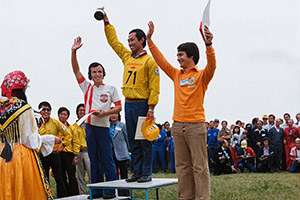
A brief ceremony was held at meet`s end. and the International Tournament o( Champion’s perpetual trophy was awarded by Bill Bennett and Miss Tournament of Champions. Chrissy De Francesco (daughter of M A.N.’s owner Dr. Louis De Francesco), to Hanno Prettner Mang along with a check for $5.000. Hanno journey home $6.000 richer ; not bad for three days fun. Second place drew §2000, 3rrd , §1500, 4th §1000 and 5th $500.

Did the Las Vegas affair meet its objectives? It would seem so; many spectators were drawn to the field by the dollar sign and the attendant publicity will reap further “image” towards. Certainly the inclusion of representatives from seven foreign countries met the objective of a truly international event not associated with a World Championship. In the future the event could well rival the FAI World Championship itself as the most prestigious of modelling affairs.

Whether the prize money was the lure – it must have been to some degree – or whether Las Vegas was the lure is unclear.
It really isn`t important since no one can deny that the idea that was planted in the Nevada`s desert nurtured by Bill Bennett and Walt Schroder, has taken root and will be a pinnacle for R/Cèrs to reach for in years to come. Bill Bennett announced that the Second Annual International Tournament of Champions is set for 1975- prize level , at least $20,000!
Some concern was evident among American competitors and spectators that only two U.S. flyers place in the top five. Statements were flying around that this did not bode well for the not bode American Team in 1975’s World Championship in Switzerland.
Not so—on any given day the lop ten at Vegas could swap their order. One point in a series of 15 K factor maneuvers makes quite J difference: a 10 an a Figure M nets 900 points over six judges: a nine gets you 10-90 points down. Blow one maneuver and the placings change substantially.

Prettner and Matt are very precise flyers and are not prone to many mistakes in their patterns. They were certainly the most precise at Las Vegas. Brown has a more open style, but he has all the potential.

Koger and young Radcliff were pleasant surprises. Our Team is likely to have a different look when it is finally selected in spring of next year. Interesting to note that the four top Americans at Las Vegas were all from Mid-America (Ohio and Nebraska).

Who said year-round flying weather is needed? Looming behind it. all was the unfortunate absence of Rhett Miller. The “Tallahassee Kid” just couldn’t give up any more time from school, the Hutchinson nonsense had already cost him a week of scholastic work. Rhett is a flyer of similar style to Prettner and Matt–almost machine-like; every pattern practically superimposed over the previous one.
It’s not fair to speculate how Miller would have done at the affair; we’ll find that out in Switzerland. That comes out as a prediction that Rhett will make the Team, doesn’t it—well, so be it!
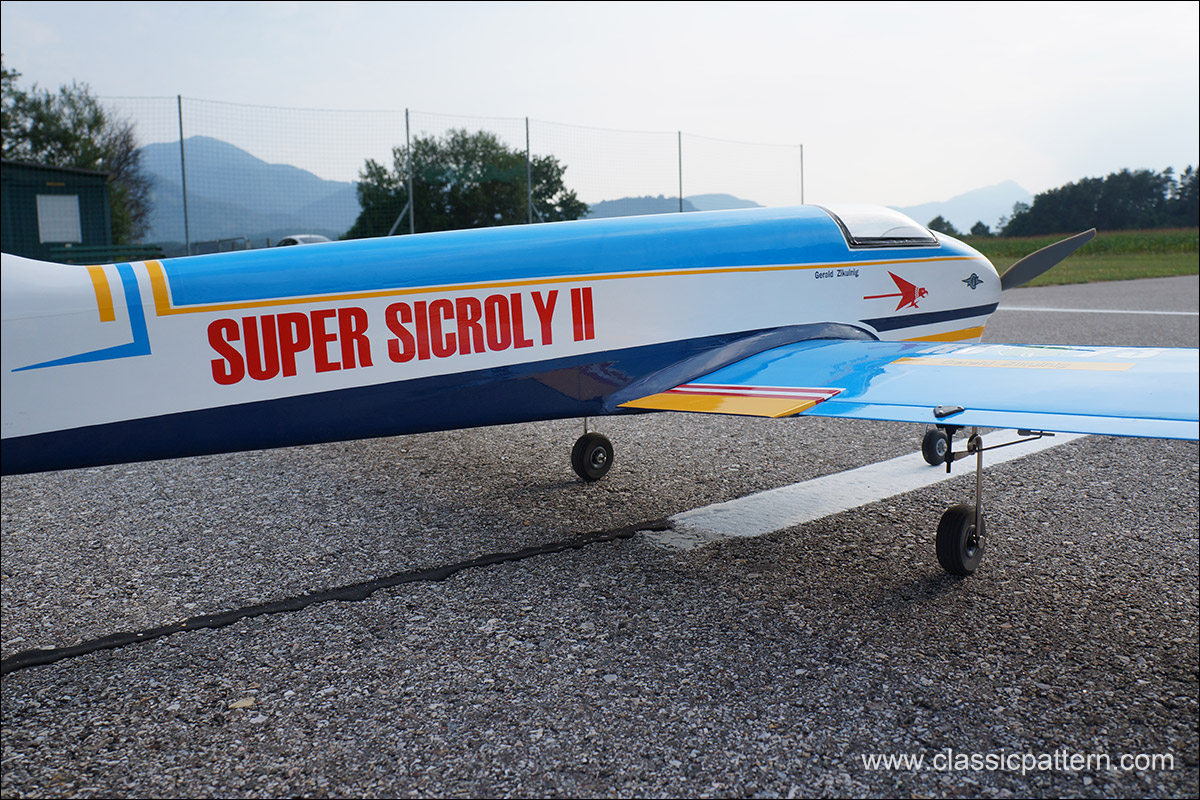
Prettner flew his Super Sicroly II, powered by an Webra Speed 61 and controlled by Simprop radio. The pattern bird weighs 8 lb. and is quite fast- anything with the big Webra in it must be. Flaps are employed, and these seem particularly effective. Of particular note is the sizeable lateral area of the fuselage’s .54″ length that seems to really help on the knife edge portion of point maneuvers.

We`ll bet that very little to rudder is needed. The aircraft is very smooth and exhibits no nasty snap characteristics. It follows the European FAI trend and is worthy of any serious pattern flyer`s consideration.
Wolfgang Matt’s plane was similar to Prettner’s including the Webra Speed and the Simprop radio. Interesting to note that Matt outpointed Prettner at Gorizia, Italy, in last year’s World Championships.

They reversed things at as Vegas, and we must wonder what might have happened if Yoshioka hadn’t crashed on his first flight. Both Prettner and Matt are in their early twenties. When you couple that with the obvious youth of Brown, Koger, Radcliffe and the missing Rhett Miller, one begins to feel that R/C pattern is rapidly becoming a young man’s game.

Well, we charter members of the, “Over-The-Hill Club” have Don Lowe to count on, #7 ain’t half bad! Dave Brown continued his impressive contest record with a Don Lowe designed Phoenix VI with ST 60 ABC power and World Engine’s Expert radio. Dave has been knocking on the door for the past few years, and we feel he’s a good bet for a Master’s place—perhaps even a win!
We have been impressed with Ivan Kristensen’s flying in the past and frankly feel the Canadian champ has not yet reached his peak. When he does—look out! Saturn, Ivan’s original design, shows some Cutlass influence; Cutlass is a design Ivan has used for .the past few years.

Smoothness is a hallmark of his style with moderately large maneuvers; his ship appeared to be not quite as fast as most Americans tend to prefer. Saturn will be published in M.A.N. in the near future. An airplane that always impresses this writer Norm Page’s Mach I, familiar to all. Norm was ‘ flying well, and we believe he will continue to be. heard from in the future.

Norm has been using dual rate control on both aileron and elevator. This method actually provides moderate and maximum throw for smoothness on the low side and rapid attitude change on the fast. Aileron rate necessary for the back part of the new Top Hat and the roll portion of the Rolling Eight is often too much for smooth flying in the rest of the pattern. Some feel that these additional controls, along with slow toll buttons, should be outlawed; that a flyer should control his craft with only the primary sticks.

Original design, Super Duck, was Dean Koger’s entry. A smallish aircraft that really moved out on its Webra Speed power. Super Duck is typical of American design and wide open style. Koger proved himself a top performer, and we look for more.

The biplane association has done just that in the new provisional rules. The controversy will probably grow, but the number of flyers we see with dual rate “whatevers” is large, and we guess they are here to stay.

Phil Kraft’s big bird may yet show the way. Equipped with spoilers, Kraft showed very precise landings with the little doors that popped from the wing’s upper surface. Wind doesn’t bother this ship too much and with the powerful Kraft 60, the size is very practical. Ability to fly a smooth, tight pattern within the FAI frame is a big airplane’s main virtue, and Kraft showed this to good effect.
The Japanese contingent used a tape read-out device that showed actual increments of command transmitted. Each command for every function was traced, and it was fascinating to watch the diagram of an Eight-Point Roll. With some flyers each aileron blip was obviously of the same duration and intensity; with other flyers the eight blips varied widely. We imagine one could learn a great deal about his own flying ability by studying a taping of his flight.

Both Saturday and Sunday were highlighted by helicopter demonstrations by Mr. Oki of MRC helicopter fame; the Dubro team headed by Dave Grey; and Ernie Huber (present American helicopter champ who just finished filming of “Towering Inferno,” a super crisis film in current release) and Aubrey Radford, both of the Kavan team.

The demos proved to all that helicopters have come of age; one impressive flight after another! Big hit was Radford’s loops and rolls with his Kavan machine. I saw it and still don’t believe it! Dan McCan joined the rotary festivities with a demo of his fantastic, Nat’s winning Aerocommander Shrike. Fixed wing aside, young McCan really turned the crowd on.

Joe Bridi’s company will he producing this fine, twin engine machine in the near future. Great show, great site and more to come in ’75. One’s competition dreams may well place him on the line at the 1975 Second Annual International Tournament of Champions in Las Vegas—failing that, plan to spectate. Either way you can’t lose. and we would sure like to spectate with you. See you then?
Text: MAN Editorial Team
Images: Benny Kjellgreen